
Second of a three-part series, Your Home for Life, published in Quepolandia Magazine (May/June issue, p. 46, https://www.quepolandia.com/).
Last time, we talked about the passage from car to door—lighting, paths and covered walkways that make arriving at your home safe and welcoming for everyone.
Now, let’s go inside.
Multi-level homes are everywhere on the coast. That’s how we capture the view, manage a slope, or separate day from night activities. Looking ahead, that’s also the feature most likely to complicate your life as you get older or if a family member loses mobility.
Level up with a lift
There are few more significant changes you can make than installing an elevator before you think you need it. A lift can be installed on an exterior wall, tucked into an existing staircase, or integrated into a renovation in a way that feels well-designed—not just serviceable.
Custom residential elevators are more compact, appealing and affordable than most people expect. Adults like their ease of use. Pets ride them. Children love them. And they add meaningful value to your property in the competitive coastal real-estate market.
Best of all, they make daily life sweeter for everyone in the household: carrying drinks and groceries, moving luggage and sports gear, or transporting furnishings between floors.
Secure your walkways
You can be safe walking around your home at night while still enjoying a cozy, stylish atmosphere. Soft, motion-activated lighting shows the way over thresholds and along passageways, low enough to be calm but bright enough to avoid obstacles like toys and pets.
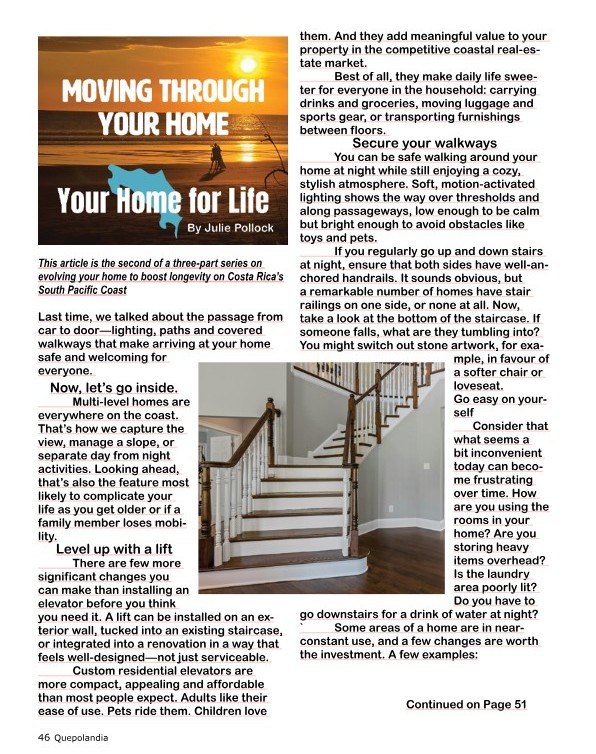
If you regularly go up and down stairs at night, ensure that both sides have well-anchored handrails. It sounds obvious, but a remarkable number of homes have stair railings on one side, or none at all. Now, take a look at the bottom of the staircase. If someone falls, what are they tumbling into? You might switch out stone artwork, for example, in favour of a softer chair or loveseat.
Go easy on yourself
Consider that what seems a bit inconvenient today can become frustrating over time. How are you using the rooms in your home? Are you storing heavy items overhead? Is the laundry area poorly lit? Do you have to go downstairs for a drink of water at night?
Some areas of a home are in near-constant use, and a few changes are worth the investment. A few examples:
- Well-considered shelves can reorganize storage so that heavier objects are kept around waist height.
- Ambient lighting inside cabinets can help you see spices, cups or dishes without climbing or stretching to find it.
- Ensuring there’s a bedroom and full bath on the same floor as a kitchen means stairs become optional rather than mandatory for daily life, even before an elevator is installed.
Widen the doorways
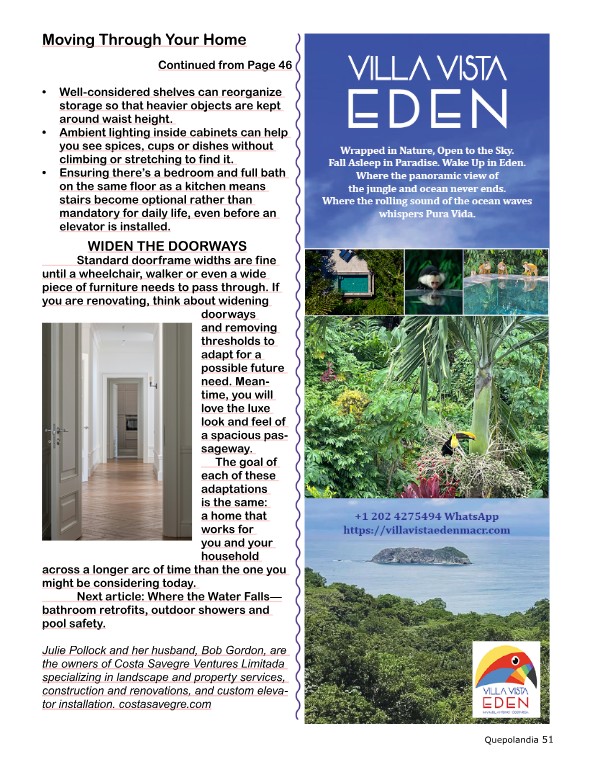
Standard doorframe widths are fine until a wheelchair, walker or even a wide piece of furniture needs to pass through. If you are renovating, think about widening doorways and removing thresholds to adapt for a possible future need. Meantime, you will love the luxe look and feel of a spacious passageway.
The goal of each of these adaptations is the same: a home that works for you and your household across a longer arc of time than the one you might be considering today.
Previous article: A Warmer Welcome
Next article: Where the Water Falls
Julie Pollock and her husband, Bob Gordon, are the owners of Costa Savegre Ventures Limitada specializing in landscape and property services, construction and renovations, and custom elevator installation. costasavegre.com

Q&A: A safer home
What does this article cover? The inside of your home—specifically, how to move between floors and through rooms safely and comfortably as your family’s needs change over time.
What’s the biggest change you could make? Installing an elevator before you think you need one. Multi-level homes are everywhere on this coast, and stairs are very likely to complicate daily life down the road. A home lift is more compact, affordable and attractive than you might expect.
What about the rest of the interior? Three things worth consideration: night lighting in corridors, tripping obstacles such as thresholds, sturdy handrails on every staircase, and doorways wide enough to allow a walker, crutches or wheelchair through freely.
Any advice that isn’t about mobility specifically? Think about how you use your home, day to day. Heavy things stored too high, a laundry area that’s poorly lit, a stairway without . Small reorganizations and a few targeted improvements make a home easier to live in at any age.


2 responses to “Moving Through Your Home”
[…] Next article: Moving Through Your Home […]
LikeLike
[…] Previous article: Moving Through Your Home […]
LikeLike